
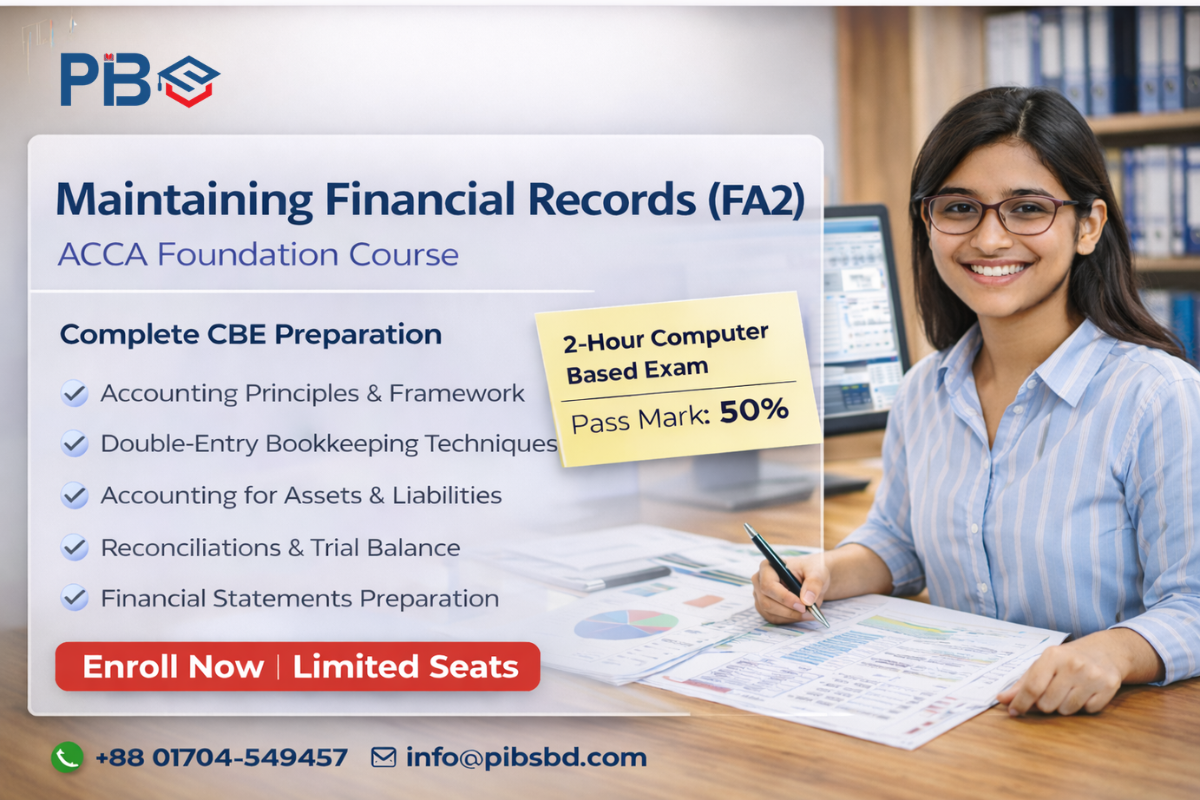
FA2″ typically refers to the ACCA (Association of Chartered Certified Accountants) exam titled “Maintaining Financial Records”, which is part of the Foundations in Accountancy suite.
ACCA FA2 Syllabus Overview
The primary aim is to develop knowledge of the underlying principles and concepts of double-entry bookkeeping and technical proficiency in preparing basic financial statements.
- Accounting Principles & Framework: Includes generally accepted accounting principles (GAAP), the regulatory framework, and the qualitative characteristics of useful financial information (e.g., relevance, faithful representation).
- Double-Entry Bookkeeping: Mastering the recording, processing, and reporting of business transactions and events in journals and ledgers.
- Accounting for Assets & Liabilities: Specific focus on non-current assets (depreciation, disposals), inventory valuation (FIFO, AVCO), and provisions.
- Reconciliations: Performing bank reconciliations and reconciling control accounts.
- Trial Balance & Errors: Preparing a trial balance and identifying/correcting errors via suspense accounts and manual journal entries.
- Financial Statements: Preparing statements (Statement of Profit or Loss and Statement of Financial Position) for sole traders and partnerships.
Key Learning Outcomes
By the end of the course, candidates should be able to:
- Explain key accounting concepts like going concern, accruals, materiality, and prudence.
- Record transactions for sales, purchases, cash, and bank.
- Calculate and account for sales tax (VAT) and various discounts.
- Process year-end adjustments, including accruals and prepayments.
- Construct accounts from incomplete records.
- Analyze the impact of errors on reported profit and financial position.
Exam Format
- Duration: 2 hours.
- Structure: 50 objective questions (MCQs), each worth 2 marks.
- Delivery: Available as a computer-based exam (CBE) or paper-based exam.