
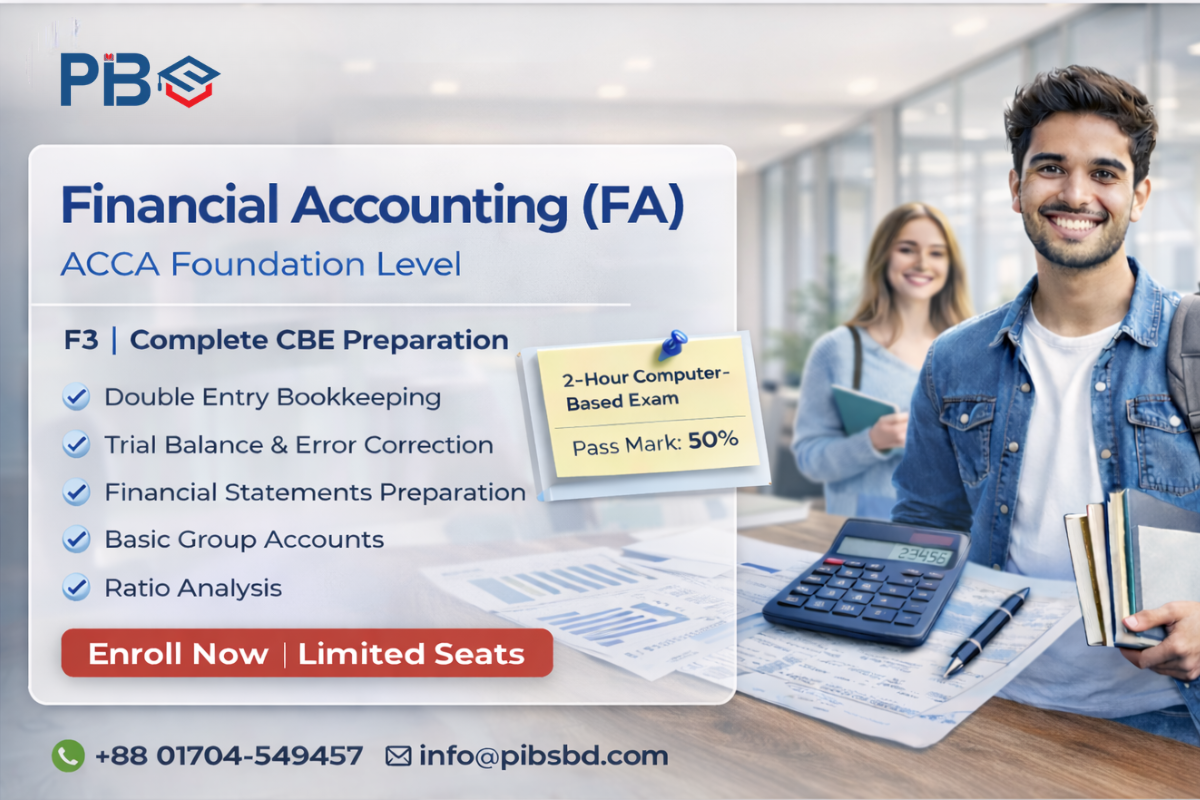
In the ACCA (Association of Chartered Certified Accountants) framework, FA (Financial Accounting)—also known as F3—focuses on the preparation of financial records and statements for both single entities and basic groups.
ACCA F/FA Syllabus Overview
The curriculum is divided into seven main areas:
- The Context & Purpose of Financial Reporting: Understanding the regulatory framework, the role of the IASB, and the qualitative characteristics of financial information.
- Qualitative Characteristics of Financial Information: Identifying relevance, faithful representation, and enhancing characteristics.
- Double-Entry Bookkeeping: Mastering ledger accounts, journals, and the accounting equation.
- Recording Transactions & Events: Accounting for sales, purchases, cash, inventory (IAS 2), non-current assets (IAS 16), accruals, prepayments, and provisions.
- Preparing a Trial Balance: Correcting errors, performing bank reconciliations, and managing control accounts.
- Preparing Basic Financial Statements: Constructing a Statement of Profit or Loss, Statement of Financial Position, and Statement of Cash Flows for sole traders and limited companies.
- Consolidated Financial Statements: Basic preparation of group accounts (subsidiaries and associates) excluding complex group structures.
Key Learning Outcomes
By the end of the module, candidates should be able to:
- Explain the context and purpose of financial reporting.
- Define and apply the qualitative characteristics of financial information.
- Record transactions accurately using double-entry bookkeeping.
- Prepare a trial balance and correct bookkeeping errors.
- Draft financial statements for single entities and simple groups.
- Interpret financial statements using basic ratio analysis.
Exam Format
- Type: 2-hour computer-based exam (CBE).
- Section A: 35 objective test questions (2 marks each).
- Section B: 2 multi-task questions (15 marks each) focusing on Financial Statement Preparation and Group Accounting/Cash Flows.
- Pass Mark: 50%.