
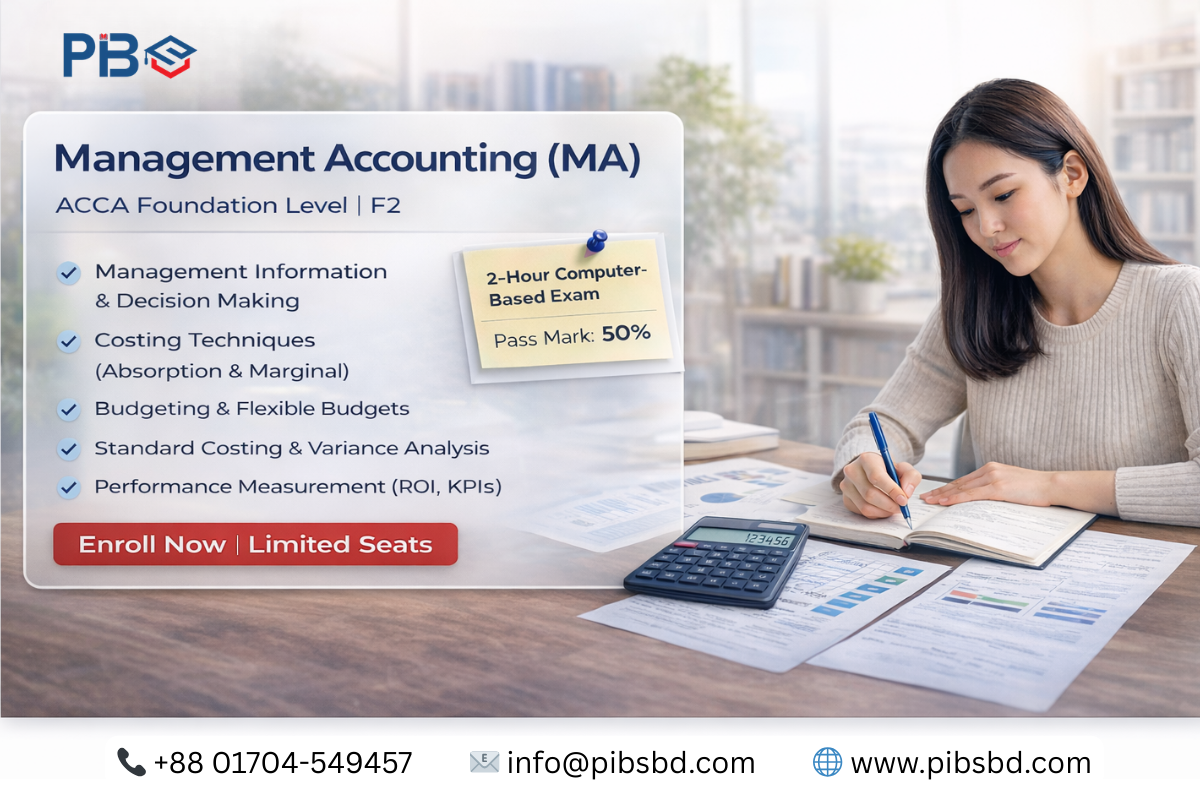
In the ACCA (Association of Chartered Certified Accountants) qualification, MA (Management Accounting)—also known as F2—teaches you how to use quantitative and qualitative data to support business planning, decision-making, and control.
F/MA Syllabus Overview
The syllabus is organized into six fundamental areas:
- The Nature, Source, and Purpose of Management Information: Distinguishing management accounting from financial accounting and identifying data sources.
- Data Analysis & Statistical Techniques: Using sampling, forecasting methods (like high-low and regression), and spreadsheets to analyze business data.
- Cost Accounting Techniques: Accounting for materials, labor, and overheads using methods such as absorption, marginal, and process costing.
- Budgeting: Understanding the budgeting process, preparing functional budgets (sales, production, cash), and using flexible budgets for control.
- Standard Costing: Establishing standard costs and calculating variances (material, labor, overheads) to identify performance gaps.
- Performance Measurement: Monitoring business health through financial and non-financial indicators, including Return on Investment (ROI) and the Balanced Scorecard.
Key Learning Outcomes
By the end of the course, you should be able to:
- Explain the role of management information and its attributes.
- Apply statistical techniques to forecast costs and revenues.
- Prepare cost records for different products or services.
- Construct budgets and use them to plan and control business activities.
- Calculate and Reconcile variances between actual and standard results.
- Assess organizational performance using appropriate financial and non-financial metrics.
Exam Format
The MA exam is a 2-hour computer-based exam (CBE) with a 50% pass mark.
- Section A: 35 objective test questions (2 marks each) covering the entire syllabus.
- Section B: 3 multi-task questions (10 marks each) specifically testing Budgeting, Standard Costing, and Performance Measurement.